

Welcome to the Sales Leader of Influence™ Hub
Welcome to the Sales Leader of Influence™ Q&A Hub
This is your direct line into the real questions Sales Leaders, Executives, and High-Potential Managers are asking as they lead teams, protect revenue, and navigate AI-driven change.
Here you’ll find:
• Clarity – straight answers on coaching the human, driving pipeline velocity, and leading at an executive level.
• Conviction – battle-tested perspectives so you stop coaching symptoms and start protecting revenue earlier.
Here you’ll find questions grouped into the 5 dimensions of The Sales Leader of Influence Method™ – the same framework measured in the Revenue Risk Diagnostic:
Module 1: Positioning (Authority Under Pressure)
Module 2: Presence (Decision Psychology)
Module 3: Precision (Revenue & Role Clarity)
Module 4: Profitability (Leadership Intervention)
Module 5: Prominence (Executive Influence)
This Hub is here to cut through the noise, give you direct answers, and show you the fastest path to scaling performance through codified influence.
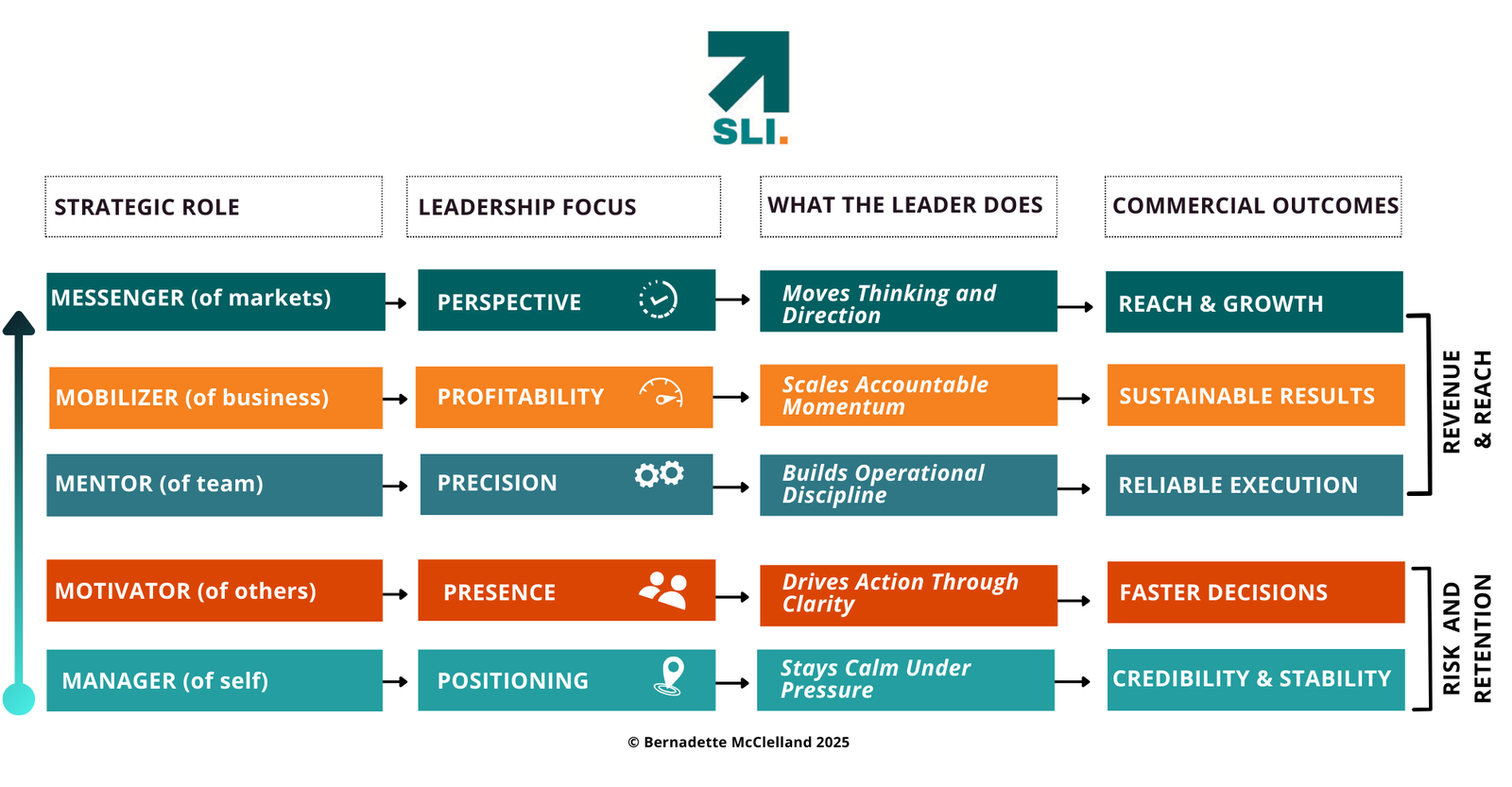
MODULE 1 – POSITIONING: Authority Under Pressure
Q1. How does The Sales Leader of Influence differ from the Traditional sales leader?
A. The Sales Leader of Influence operates with clear decision standards that stabilise revenue outcomes. Traditional sales leadership focuses on activity and outcomes without governing how decisions are made, leading to late-stage intervention, forecast volatility, and reactive leadership.
Q2. Is there a path in becoming A Sales Leader of Influence™?
A. Yes. The Sales Leader of Influence Method™ defines five leadership standards that progressively improve decision quality, execution consistency, and market authority – from internal reliability to external influence.
Q3. What mistakes do sales leaders make when positioning themselves for change?
A.The most common mistake is addressing performance symptoms instead of decision structure — intervening late instead of governing earlier where outcomes are determined.
Q4. What mistakes do traditional sales leaders make that Sales Leaders of Influence™ avoid?
A. Traditional leaders rely on heroics and personal intervention. Sales Leaders of Influence operate from standards that reduce dependency, clarify ownership, and make performance predictable.
Q5. How do I position myself as a credible sales leader in an AI-driven world?
A. By operating from clear leadership standards that govern decisions, not personality. Credibility now comes from reliability, not charisma.
Q6. What is Deliberate Disruption™?
A. Deliberate Disruption™ is the leadership discipline of interrupting default decision patterns before they create execution risk – allowing leaders to reset direction early instead of correcting late.
Q7. Why does influence matter more than intellect today?
A. Because decisions are not funded on logic alone. Influence determines whether commercial intent translates into commitment at executive level.
Q8. Why is congruence a differentiator?
A. Congruence means leaders act consistently across decision-making, communication, and execution. This consistency is what builds trust, reduces escalation, and stabilises outcomes.
Q9. How do I strengthen the part of leadership AI can’t replace?
A. By strengthening judgment, decision framing, and early intervention – the leadership capabilities AI cannot replicate and organisations now depend on.
Q10. What does Go Vertical™ mean?
A. Go Vertical™ means reducing time-to-decision by intervening earlier, clarifying direction sooner, and removing friction before it compounds.
MODULE 2 – PRESENCE: Decision Psychology
Q11: Why does human influence matter more now that AI handles information?
A. Because AI processes data, not hesitation, trust, or commitment. Leaders must govern the human factors that determine whether decisions progress or stall.
Q12: Why is understanding motivation critical in times of uncertainty?
A. Because uncertainty distorts decision-making. Leaders who understand how people respond to risk can stabilise performance instead of chasing symptoms.
Q13: How do I understand my own decision patterns?
A. Leaders must understand their own decision defaults to avoid projecting bias into pipeline direction, pacing, and pressure.
Q14: What’s the risk of weak connection with the team?
A. Weak connection leads to hidden risk – problems surface late, decisions slow, and leaders are forced into reactive escalation.
Q15. What does CARES™ stand for?
A. CARES™ is the proprietary model used to decode the conditions that affect decision confidence, engagement, and execution reliability (Certainty, Autonomy, Recognition, Equity, Security) so leaders can replace guesswork with predictable, strategic engagement.
Q16: How do I know if psychologically safety is dropping?
A. Silence, hesitation, and surface agreement under pressure signal declining safety – which precedes performance drop-off and pipeline distortion.
MODULE 3 – PRECISION: Revenue & Role Clarity
Q17. Why is a lack of role clarity a weak revenue strategy?
A. Because unclear roles create unclear decisions. When authority is vague, decisions slow, escalation increases, and leaders intervene too late. Revenue doesn’t become unpredictable because of selling effort – it becomes unpredictable because decision ownership collapses under pressure.
Q18. What’s the real difference between a job description and true role clarity?
A. Job descriptions list responsibilities. Role clarity defines decision authority. Predictable revenue exists only when leaders and sellers know exactly which decisions they own, which they influence, and which must escalate – without negotiation.
Q19. What is a Perception Audit and what impact does it have on revenue?
A. A Perception Audit exposes the gap between how roles are intended to function and how decisions are actually being made. Revenue leakage occurs when leaders believe decisions are governed, but teams are operating on assumption and habit instead of clarity.
Q20. How does a Perception Audit improve execution speed?
A. It removes hesitation, duplication, and escalation loops by clarifying who decides what and when. When authority is explicit, work moves without waiting for reassurance, permission, or rescue – accelerating revenue movement without increasing pressure.
Q21. Why does revenue stall even when activity levels are high?
A. Because activity does not equal decision progress. Revenue stalls when decisions remain unowned, deferred, or avoided – even when effort looks strong. Without clear decision commitment, volume creates noise, not movement.
Q22. What is the earliest signal that revenue is at risk?
A. Decision delay. When leaders notice decisions surfacing later, escalating more frequently, or being revisited repeatedly, revenue risk already exists – long before results reflect it.
Q23. Why do leaders get pulled into deals late?
A. Because decision boundaries weren’t enforced earlier. Late intervention is rarely about deal complexity; it’s about authority drifting under pressure. Leaders get pulled in when escalation replaces governance.
Q24. What leadership practices create true commercial clarity?
A. Clear decision ownership, explicit escalation boundaries, and consistent decision checks. Clarity doesn’t come from more process — it comes from leaders holding authority steady when pressure rises.
Q25. What’s the difference between interest and commitment?
A. Interest signals engagement. Commitment requires a decision owner, defined risk, and consequence of delay. Revenue advances only when commitment exists – not when interest is visible.
Q26. How do leaders maintain control without micromanaging?
A. By governing decisions, not activity. When leaders focus on what decisions must move, teams gain autonomy while leadership retains authority. Control increases as interference decreases.
Q27. What is the commercial risk of vague expectations?
A. Vague expectations force teams to guess. Guessing creates inconsistency, escalation, and unreliable reporting. Precision in decision authority is a leadership responsibility, not an operational preference.
Q28. How does role clarity improve forecast confidence?
A. When ownership is explicit, information reflects decisions rather than optimism. Leaders receive earlier, cleaner signals because teams report what has been decided – not what they hope will happen.
Q29. How do leadership cadences affect revenue clarity?
A. Cadence governs decision rhythm, not activity rhythm. Predictable decision cadence surfaces risk earlier and prevents urgency-driven escalation. Inconsistent cadence allows pressure to accumulate silently.
Q30. How do codified decision frameworks improve revenue flow?
A. They standardise how leaders assess ownership, escalation, and commitment. This reduces internal debate, shortens decision cycles, and prevents repeated rework under pressure.
Q31. What is the real competitive edge for sales leaders in the AI era?
A. The ability to govern decisions earlier than competitors. AI accelerates execution everywhere; leadership advantage now comes from clarity, authority, and decision discipline — not information.
Q32. What’s the difference between managing work and mentoring commercial judgement?
A. Managing work tracks activity. Mentoring commercial judgement builds decision capability. Sustainable revenue depends on leaders developing how decisions are made — not just what gets done.
MODULE 4 – PROFITABILITY: Leadership Intervention
Q32. What is the difference between solving symptoms and solving sources?
A. Symptom correction fixes individual deals. Source correction governs decision patterns that repeatedly create friction, delay, or discounting across the pipeline.
Q33. Why is addressing decision behaviour essential to scaling performance?
A. Because behaviour follows decision logic. Without changing how decisions are framed and assessed, activity-based management only produces short-term compliance.
Q34. How does this approach change discounting or premature proposals?
A. It reframes discounting as a decision-risk signal, not a negotiation issue. Leaders intervene earlier, preserving margin and deal integrity.
Q35. What is the D.E.A.L. framework’s commercial value compared to standard objection handling?
A. It gives leaders a repeatable method to diagnose decision friction and redirect momentum without escalation or pressure.
Q36. How does the R.E.W.I.R.E. framework deliver faster results than traditional sales training?
A. It replaces reactive decision habits with structured responses under pressure, improving consistency in high-value opportunities.
Q37. How does the Q4 Quadrant™ qualification model compare to traditional BANT or MEDDIC in driving deal velocity?
A. It surfaces decision readiness by examining money, motivation, risk, and meaning – the factors that actually govern executive commitment.
Q38. What can Scotsman 2.0 surface that AI and data analytics cannot?
A. Human hesitation, timing misalignment, and trust gaps that data alone cannot detect – all of which directly impact deal closure.
Q39. Why coach the human and the deal simultaneously?
A. Because decision quality determines deal quality. Separating them delays resolution and increases escalation.
Q40. How does this shift accountability ?
A. Accountability becomes decision-based rather than punitive, increasing ownership and reducing defensive behaviour.
Q41. Why use Pre-Deal Briefs and Post-Deal Debriefs?
A. They convert each deal into decision intelligence, continuously improving execution standards across the team.
Q42. Why is codified IP non-negotiable now?
A. Codified IP enables consistency, scalability, and AI-supported execution. Uncodified wisdom cannot be transferred or sustained.
Q43. How does Deliberate Disruption™ prevent wasted time?
A. It forces clarity-to-action within each leadership interaction, ensuring momentum rather than discussion.
MODULE 5 – PROMINENCE: Executive Influence
Q44. What’s the risk of not turning leadership thinking into IP?
A. Without IP, influence remains personal and fragile. Codified thinking protects authority and enables scale.
Q45. What’s the measurable outcome of operating at the Messenger level?
A. A leadership system that continues to drive revenue, trust, and alignment beyond individual presence.
Q46. What protects relevance in the AI era?
A. Clear decision frameworks that AI can support but not replace.
Q47. Why does codified IP outperform informal wisdom?
A. Because it creates transferable value, commercial leverage, and strategic credibility.
Q48. How do frameworks scale influence?
A. They allow leadership thinking to operate consistently across teams, stakeholders, and markets.
Q49. How do leaders influence executives more effectively?
A. By presenting structured models that reduce risk and clarify outcomes, not opinions.
Q50. Why does story matter commercially?
A. Because story frames risk and value faster than data alone, accelerating executive understanding and decision confidence.
Q51. What separates compelling story from performance?
A. Structure, relevance, and direct linkage to a commercial problem.
Q52. How does grounded influence build prominence?
A. Consistency and certainty create trust — trust creates authority.
Q53. Why are communication and framing essential leadership skills now?
A. Because clarity cuts through complexity and drives commitment under pressure.
Q54. How does creativity accelerate stalled deals?
A. It reframes constraints, revealing decision paths competitors overlook.
LEVEL SIX: ACCELERATING INVESTMENTS
Q55. How do I know if I’m ready to invest in help?
A. You’re ready when leadership effort is increasing but outcomes are not. Common signals include stalled deals, inconsistent forecasts, repeated rework, and leaders stepping in late to fix preventable issues. At that point, the cost of delay outweighs the cost of installing a better leadership system.
Q56. How do I avoid wasting budget on the wrong training?
A. Avoid programs that rely on motivation or generic best practice.
Invest in codified leadership IP that can be applied consistently, repeated under pressure, and embedded into how decisions are made. If it can’t be named, modelled, or reused – it won’t change execution.
Q57. What if I’ve already invested in programs that didn’t deliver?
A. Most programs fail because they focus on activity, not decision structure. This system works differently – it installs leadership standards that govern how decisions are framed, tested and committed, so results are not dependant on individual effort or enthusiasm.
Q58. What if I’m not sure what my leadership edge actually is?
A: Your leadership edge is defined by the decisions you consistently improve. We codify those patterns into frameworks so your judgment can be applied by others – not just relied on personally.
Q59. Isn’t it risky to invest in leadership growth when budgets are tight?
A. The highest risk in constrained environments is inconsistent execution. Leaders who govern decisions clearly reduce rework, protect margin, and improve forecast reliability – which is exactly what boards expect in tighter conditions.
Q60. What if my industry is crowded and everyone is doing the same thing?
A. In crowded markets, differentiation comes from how decisions are framed – not what’s being sold. Leaders who introduce clear models and language influence how buyers evaluate risk, value, and urgency.
Q61. Do I need certifications to advance my leadership career?
A. Certifications signal competence. Codified thinking signals leadership. Executives advance leaders who can create clarity, guide decisions, and improve execution across teams – not those who simply complete programs.
Q62. What if my team or execs resist change?
A. Resistance usually reflects uncertainty, not opposition. When leaders introduce clear frameworks instead of opinions, resistance drops because expectations, roles, and decision paths become explicit.
Q63. What if I try it and the results don’t happen as quickly as I want?
A. Results accelerate when leaders apply standards consistently. Early indicators include clearer pipeline reviews, earlier decision clarity, and reduced escalation – all of which precede measurable revenue impact.
Q64. How do I choose between internal training and external coaching?
A. Training transfers knowledge. Leadership systems change behaviour at scale.If your goal is predictable execution, clean pipelines, and consistent decision-making, choose a system that installs standards – not one that adds activity.MESS
If you’re responsible for execution and revenue reliability, the next step is a structured review.
This conversation assesses decision standards, pipeline integrity, and leadership fit – before any commitment is made.
A confidential discussion to assess execution risk, decision clarity, and fit.